 We had some problems this year with getting zucchini fruit to set. They would grow OK for a while, then shrivel up, rot and drop off the vine.
The problem is that the fruit are not getting pollinated. This job is normally done by bees, but for some reason this year they’re not doing it. I don’t know why – we still see plenty around the garden. Strange.
So, I’m reduced to doing the job of the bees by hand-pollinating zucchini flowers.
The basic idea of hand pollination is to transfer pollen from a male flower onto the female flower. This causes the seeds in the immature fruit to become fertile, and so it grows to maturity in order to perpetuate the species. If the seeds aren’t pollinated, the plant isn’t going to waste energy growing a non-viable fruit. It just withers and drops off, and the plant tries again with a fresh flower.
The best time for pollinating zucchini flowers is in the morning, when they’re fresh and just-opened. Later in the day the heat starts to wilt the flowers and dry them out.
So how do you know which flower is male and which is female?
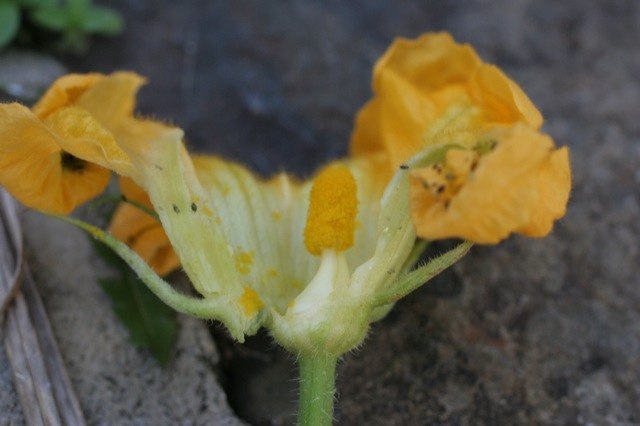
The male zucchini flower has a thin stem, and a single pointy bit inside it (the stamen) covered in dust-like pollen.


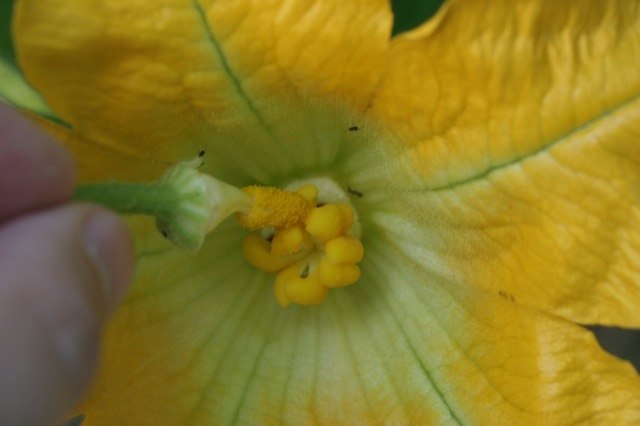
The female zucchini flower has a small fruit (ovary) behind it instead of a stem, and a more complex internal structure (the stigma).


Some people use cotton swabs or artist’s paintbrushes for pollinating zucchini flowers, but I’ve found the simplest way is to simply pick the male flower (don’t pick the female flowers!), peel off the petals, and use it like a paintbrush to dab pollen onto the stigma of a female flower. Quick and easy.
**Update:** I’ve posted photos of hand pollinating pumpkin and squash flowers, which is a very similar process.
Comments
134 responses to “Hand-Pollinating Zucchini Flowers”
I do not believe that heat has nothing to do with the flowers closing (at least I have not read anything to this effect). Different types of cucurbits will close open and close their flowers at different times. Although I am not quite sure what the trigger is for each plant. For instance watermelons will often open their female flowers later in the day although their male flowers will be open all day.
My morning garden routine always consists of pollinating members of the curcurbitaceae family, with the only exception being cucumbers which get pollinated very well by other insects. I even hand pollinate watermelons which can be a bit tricky.
Another trick I have used for years is that when there are no male flowers from a zucchini, I will use the male flower from a button squash or pumpkin (and visa versa). Now if you were going to save seed from that female plant this would not be a good thing to do. But to get the fruit to set, it works extremely well. 🙂
@Jason: Good tip on using squash or pumpkin flowers to pollinate zucchini! I had wondered if that would work, but hadn’t tried it. I assume it works in the reverse as well, using zucchini to pollinate pumpkins?
Thank you for this information. Possibly the problem we had a few months ago before we gave up and pulled out the plant.
@Gustoso: We didn’t have much luck with the last lot of zucchini and cucumbers we planted. I’m pretty sure it was due to lack of pollination – they were in a spot I didn’t get to much, and I had assumed that the bees were taking care of things for me.
@Jason: Thanks for the follow-up info!
I would not pollinate true pumpkins using a male zucchini flower. The main reason for that is that pumpkins are left to fully mature. Using pollen from different plants can change the end result. However with plants such as zucchini and button squash, the fruit is used immature. Thus there is no significant change in the fruit before it is picked.
I have used butternut squash to pollinate Kent/Jap pumpkins and visa versa. But I make sure that I note which ones I did this with and not save the seed from that fruit.
Back in Wollongong we pollinated a zucchini with a butternut squash. I let the fruit mature and that really seemed to mess up the zucchini plant (it kinda died after that). We called the end result a zuckin, but I have no plans to repeat this experiment.
I had to do the same thing in my area with the zucchini this year. Only the females that I hand pollinated actually grew to a decent size. The bees avoided them and the pumpkin patch like the plague. I had to hand pollinate the butternut and golden nugget pumpkins with this method as well. Same as your case, plenty of bees around, but they were more interested in the citrus and other flowers.
Gav
@Gavin: Yes, we had the same with our butternuts too. It was driving me crazy seeing all the pumpkins drop off the vines. By the time I twigged that I needed to hand pollinate, we only got about 6 pumpkins. Still, they were great!
Have you had to hand pollinate your zucchini flowers before? I ask because I have heard there has begun to be a shortage in bees and I was wondering if that had anything to do with it.
This is great information. I only have a few plants so I am a beginner gardener. I never heard of hand pollinating.
Thank you for the great post!
@Kate: I have hand-pollinated a bit before, but not really as a routine. We were a bit more half-hearted with previous zucchini-growing attempts :-). We did get fruit though, so the bees must have been doing some work! We have a hive in the park near our house, and I see bees around the garden, so I know they exist in this area. In previous years we’ve grown sunflowers etc, and we didn’t plant them this year, so maybe we’re just not attracting as many bees to our yard at the moment.
I got no pumpkins and very few zucchini this year, wonder if it was because I had pulled out the overgrown lavender which was always covered in bees in the past. Are you actually growing zucchini at the moment or are those photos from the summer?
@Greenfumb: No, I’m actually still growing zucchini, although those photos were taken on April 7. I planted these ones quite late, but they’re doing well and still producing. I’ve never grown them this late before, but I think that’s just because I’ve never tried!
@Wilson: Hehe, glad you found the photos helpful :-). Do you have a recipe for your zucchini pickles?
Darren, when I’m reading your post, it sounds like you’re the botanical lecturer in the university! Good presentation with beautiful pictures here.
By the way, I normally used the Zucchini to make the “Zucchini pickles”, it tastes really good! 🙂
[…] Change has an excellent illustrated post on hand pollinating zucchinis. This could have been the reason we only got one zucchini a few months ago. If only I had known! […]
Hi again, I’ve linked to this post in our recent gardening update.
http://gustoso.wordpress.com/2009/05/24/rain-rivulets/
Hope you don’t mind and let me know if you want anything changed. 🙂
@Gustoso: Thanks! Looks great to me. Better luck next time with the zucchinis – and let me know if hand pollinating helps.
Absolutely, Darren. I’m love to share the pickled zucchini recipe with you! Check out this page: http://www.cookography.com/2008/pickled-zucchini-the-zuni-cafe-way
PS: You can skip the ground Turmeric powder, if you cannot withstand its exotic taste! 🙂
@Wilson: Thanks! I’ll add it to my list of recipes to try out.
I’m growing zucchini for the first time in a planter on a second floor balcony. I have carpenter bees – do you think they’re enough to pollinate the flowers, or should I hand pollinate? I know the carpenter bees are around because they leave their little piles… and my plants just started blooming this past week. Looks like 3 male flowers and 2 female flowers so far (at least the orange bits – there should be more coming.)
@Merle: I’d be hand pollinating anyway, just to be sure. You can’t really tell if the bees are doing their job until you’ve lost a few zucchinis, by which time it’s too late. It really doesn’t take any effort.
I’ve grown zucchini successfully for several years in a 8×12 greenhouse (I’m in northern BC where we had -4 C May 15.. it’s hot +28 C now though) however this year I have a pollination problem that I can’t yet solve by hand. All 6 of my zucchini plants are producing female flowers (one opens every day or 2) but NONE of the male flowers have opened yet.. so all the zuchinis fail to develop.
Does anyone know what affects the male:female flower ratio of zucchinis? The plants seem healthy: big leaves, lots of flowers coming, etc
I fertilize with a granular low in N (11 – 20 – 25 or close).
@Kerry: I think I read somewhere that pumpkins and zucchinis sometimes produce more of one type of flower (males?) when they’re young, and more of the other as they get older. Perhaps sowing in batches, each offset by a couple of weeks, might help? It’d also help prolong your harvest.
A quick Google has turned up lots of theories for having more of one type of flower than the other – lack of calcium, air/soil temperature, overwatering, not enough fertiliser, genetic anomaly, etc. I don’t know if any of them apply.
While you’re waiting for the males to show up, you can pick the unfertilised fruits while they’re still young, and fry them with the flowers on. Perhaps even with a tempura batter or breadcrumbs. You can also stuff the flowers with meat or ricotta. Yum :-).
I have a silly question, I am in SE Pennsylvania, and it has been really wet, and damp for June, my zucchine are sprotting male flowers only, my question, does one plant produce both male and female?????? thanx
@Regina: Yes, normally both male and female flowers sprout from every zucchini plant. Sometimes weather and other factors seem to cause flowers of only one type to be produced, although I’ve never found a good description or what can cause it. You can eat the male flowers while you wait for some females.
After about 3 weeks of female-only zucchini flowers (6 plants), I finally have male flowers opening! Whew.. finally some pollination.. Things will go OK now. The one yellow variety (I have the name, but not with me) has produced 2 male flowers, both without pollen, but there is enough from the greens to go around.
I’m a beekeeper and use “bee-sticks” to pollinate: I pick up a few freshly dead bees from in front of the hive, mount them on a toothpick, then use this to transfer the pollen. I can even pry open yesterday’s closed female flower and slip the bee in. I suspect the closed flower has something to do with maintaining humidity to allow the pollen tubes to grow, so tearing the petals off could hurt the process.
cheers
K.
@Kerry: That’s great news! I wonder if it’s the age of the plants or something environmental that caused them to produce only female flowers? Possibly time-staggered plantings or growing other squash family plants as well could allow more pollination options.
I”m a first time gardener and today I finally see a Zucchini growing!! Hip Hip Hooray!
BUT now I”m lost, do I have to do something more??? Reading all these posts has me so lost? Help! Doesn’t the appearence of the fruit mean the bees did their job???
I have tons of flowers.. will go look for the boys and for the girls! LOL
Having tons of luck with tomatos, peas, carrots, cukes, weak on lettuce, spinage, — my garlic is growing nicely too.
All containers.
Northern AZ, cool nights, warm to hot days.. starting to get HOT.
watering once a day, good, some plants 2x a day as they wilt from the sun.
Febe
@Febe: That’s great! It’s pretty simple – just use the male flowers to pollinate your female flowers to ensure the fruit will ‘set’. You can’t really tell if the bees are doing their job or not, unless you see them actually flying in and out of your flowers. Great to hear all your other stuff is doing well too!
Squash – Lots of open female flowers. Closed males? Planted early no frost but much rain. Seem healthy with lots of leaves. Pruned several leaves as seems too much energy spent on growing them. Some small skinny long fruit coming in but not much and not every plant.
Seems Good amount of squash bees. No pesticides yet. Gonna try to do without.
Can the males be peeled open to conduct hand the polination?
@Clint: The males should open up by themselves in time. You could try a sneak peek inside one to see if it has pollen – I’ve found when I’ve opened them early they don’t have any pollen (yellow powder) on them yet.
We have a pretty awesome organic garden going here but we would very much like suggestions on how to store excess zucchini. Any suggestions would be appreciated. Can we blanch and freeze it?
@Connee: I’ve heard of people slicing and dehydrating it for use in soups and stews over winter. You can also make zucchini cakes and freeze them. I’m sure there would be ways to pickle them somewhere in Google, too. If you have a glut, it would be worth blanching and freezing one as a test – that’s the only way to know for sure! It’d be a shame to spend a lot of time processing them only to discover in a few months’ time that they just come out a soggy mess.
@Connee: If you like using zucchini in baking (for instance zucchini bread or zucchini muffins), then the fruit can be grated raw and frozen in usable quantities (for instance 2 cups). I have done this for a couple of decades, works great.
@Jason: Top tip! Thanks!
Thanks Darren and Jason, both very good tips! The only thing we have a glut of so far is HUGE and very prolific cucumbers. Do either of you know if they freeze like the zucchini?
Thanks for the info. Had, still trying to grow zucchini for years, nothing. I will give cross pollinating the zucchinis a try. I do hope that works.
@Karen: Good luck, I hope it works for you. Let me know how you go!
I have a cucumber plant next to my Zucchini plant. The cucumbers growing seem to have a zucchini end next to the sterm and a cucumber on the starting end. It is about 10 inches long and thin. Why??
@Lori: That sounds bizarre! I’ve no idea what’s going on, but I’d love to see photos if you have them.
Darren, I have a few questions, first time garden grower here and all three of my zucchini plants had mold on the leaves, the one plant was really bad, I removed all the moldy leaves the best I could and the best that I could see and sprayed with milk, I sprayed everything and I am buying Fungonil today, my question is, since I found a female FINALLY, will it survive after I polinate the flower because of the mold problem, and how many times do I need to polinate one female and how long does it normally take the female flower to open, weve had horible rainy and chilly weather here in NE Ohio, any help would be greatly appreciated and thanks so much in advance.
@Theresa: Yes, mold can be a problem, especially if you get a long period of wet weather. Removing infected leaves and spraying with milk are the right things to do, so your plants should be OK. The mold shouldn’t affect the fruit if your treatments are successful, it might just slow down their growth rates a little. You only need to pollinate the female flower once. The opening time of the flowers seems to vary with the weather – faster in warm weather, and slower in cold weather. Good luck!
I have a zucchini plant next to the house on the east side. The plant looks good, but I have not had any zucchini set on. After reading about the male and female flowers, I checked mine. I only have male flowers. Can you tell me why this might be. Thank you.
@Bonnie: I have read that temperature, rainfall, soil pH, nutrient levels, light levels, plant age, watering frequency and other factors can cause more flowers of one gender or the other. As far as what you can do about it – I haven’t a clue! Keep persevering, and hopefully you’ll start to get some female flowers forming. Meanwhile, don’t forget you can eat the male flowers!
Thanks for all the info about hand pollinating, never had a problem before, but haven’t had many bees around this year. I will try it in the morning for my summer squash, which is producing, but very slowly. In CT we’ve had huge amounts of rain and humid weather. My zucchini is the big problem. They don’t have any flowers at all. I have 6 plants, only one has something on it that might turn out to be a male flower, I’ll keep an eye on it. Any idea why no flowers at all. Some of the plants look about the right size for this time of year and some are so tiny still. Planted last week of may.
@Louise: It sounds like maybe the wet weather has something to do with it. Keep persevering, and keep an eye on fungus problems, and hopefully you’ll get some sunshine and flowers!
Hi folks, I planted a garden for the first time and have zucchini growing like bushes in just a month in Oregon. What can you tell me about trimming leaves? Do they affect production?
@William: I sometimes trim the leaves, starting with the ones near the base of the stalk. They tend to dry out and die anyway, and I like to keep them a bit more tidy. All the fruit comes from the growing end anyway.
To Produce more female flowers in a plant you can nip the tip of most of the males to trick the plant. but remember to leave one or two. The best way to hand pollinate is from one plant to another plant using the method that was said in previous posts. if that doesnt work you have blossom end rot, little or no calcium in the soil, the cure dry milk and egg shells
@Anthony: Thanks for the tip – hopefully that answers the questions of the people above with no female flowers.
Dear Sir,
Let me know the following information’s answer.
I work at a research based seed company at Bangladesh. I do hand pollination with pollen of desired male parent and that flower is bagged with wax coated bag but after one hour of that activity some how the bag is open and a bee is entered in to the bag and I think the bee bears unexpected pollen from another flower. What does occur when the unexpected pollen fallen on the stigma ? Can the stigma allow that pollen for fertilization ? Please inform me. and give paper and reference if any.
Thanks
Mohammad Muhebbullah Ibne Hoque
Seed Production Officer
Lal Teer Seed Limited
Anchor Tower
108 Bir Uttam C.R. Datta Road
Dhaka- 1205
Bangladesh
@Mohammad Muhebbullah Ibne Hoque: I have no idea! I’m just a gardener, and with things like zucchini that are eaten immature, it really doesn’t matter where the pollen comes from as long as it’s from a plant in the same family. If it were me, though, and it was really important that the pollination were done with the male parent, I’d dump that one and try again with another flower.
Hi, great post!
It’s my first time growing zucchini and this might sound like a dumb question but I have 2 plants and 1 is a bit more developed than the other. Can I pollinate the female flowers with male flowers from the same plant or do I need to wait till the other plant develops?
Thanks
@Liberty: There’s no such thing as a dumb question, as they say! Yes, you can pollinate female flowers using male flowers from the same plant. It’ll work fine.
great! thanks for your help 🙂
I really appreciate all the detailed commentary about hand-pollinating zucchini and will try it. But I found these comments when searching for hand-pollination of peppers. I want to start a pepper farm of about 160 varieties. Some are VERY expensive (imported by the seed) and, to produce my own seeds, must be raised under row cover all the time (in order to prevent natural cross-pollination). Has anyone any experience hand-pollinating pepper plants?
@AlOlmstead: Peppers have “perfect” flowers, with both male and female parts in them. They’ll self pollinate without bees, as long as there’s a little wind or shaking of the bush to stir the pollen up. Or you can use a fine paintbrush – just touch it into each flower, being careful not to damage them.
Thanks for this info and the very instructive photos – I have had very little succes with zucchinis the last 2 years and will definitely try the hand-pollination this season.
@Pia: Let me know how you go. I hope it helps!
I only have male flowers every morning to pollinate…..is there some reason for this. I have checked on most mornings for almost one week. Very frustrating!
I have tried hand pollinating last year with little success – was hoping for better this year.
Thanks for any information you can give.
@Shelly: There’s a little info higher up in the comments about potential causes for having more of one type of flower than the other. I don’t have a definitive answer, though! Good luck.
its always hard for me to pollinate flowers, for i go home 2pm weekdays..so when a flower blooms on a weekday ( which is like 70% of the time), i have to rely on my lazy brother to do it for me. i have lost countless bitter melon flowers, aubergine flowers but i dont really mind because i understand that a potted vegetable can only support few fruits.
But these courgettes are really the most difficult to pollinate. for one, they never really bloomed ( thats my biggest issue) and maybe they do but not on a weekend when i can hand pollinate them.
but what a pleasant surprise! today ( weekend) , amongst countless male flowers and dozen of female flowers ( of various sizes) were a medium sized female flower with an open flower, and 2 male flowers ( not yet open but are already ripe). i was so delighted i immediately transferred the huge pot inside our house to protect it from our harsh weather ( windy, rainy then sunny). it was drizzling so i made sure that the inside of the female flower was dry using a cotton bud, and then i carefully opened a male flower ( one of the 2) and hand pollinated the female. i resserved the other male flower for tomorrow ( if another female will bloom) and just in case the male flowers arent that ready yet at least i have another male flower left).
Im excited ..i will post the pics sooon..
PS>…
my 2 zucchini varieties ( the one from England, all green is the one that is very very huge and is having tooo much flowers….right now im thinking if I need to remove some of the female flowers to give more energy on the remaining ones….i also noticed that some of the female flowers get to grow to a good size even if they arent pollinated yet..is it ok to consume them if in case they really dont bloom open? the lenght is about 5.5 inches and i heard that courgettes are better when smaller, so im thinking maybe i dont need all of them to be pollinated before i consume them..is that ok?
im just hoping to at least get a decent sized courgette and then another one to save for seeds.
thank you,
gevalia
@lawrence: It sounds like you’re on the right track now. Good luck!
Hello there, two questions. I have two zucchini plants that are growing large and are producing both male and female flowers. One male flower has opened, but for the most part all other flowers have remained closed. 1) Do I have to wait until all flowers open by themselves, or can I take, say, a male flower (like this open one, or one of the other males that looks almost open and most likely have pollen), and open a female flower myself to do the pollination? Or is it bad practice to do anything other than wait until both males and females have opened on their own?
Other question, unrelated to flowers: 2) The zucchini leaves have what I believe is powdery mildew. They’ve had it since they were transplanted into the ground, basically, about a month ago. I’ve been spraying with water & milk for at least 3 weeks, and the plant is growing and going, but the mildew has not abated at all. Should I make my mixture stronger? Change tactics to baking soda or something? Keep going with the milk? Thanks!
@lizanne: I usually wait until the flowers open by themselves, but I have opened a male flower “early” before when I had a few female flowers that were ready. I have also opened a female flower early before to pollinate it. In both cases, pollination worked. It sounds like you have a lot of flowers, so why not just try it with a few?
I’m not sure about the powdery mildew. It sounds like you’re doing the right thing treating with water and milk. Make sure you don’t water the plants in the afternoon/evening as well, so they don’t have wet leaves overnight.
[…] that bees or other insects won’t get the pollination work done, you can hand pollinate. This site has some great tips on hand pollination. Just look at yourself as a little artificial […]
Thanks so much for your post and photos. Very helpful.
I have about 8 zucchini plants that have been flourishing with big flowers each morning, then they shrivel up and fall off. Have seen a few bees.
After reading about hand pollinating, I went to check the flowers this morning and all of them look male. Is that possible? The same thing happened last year and no zucchini. Are there certain male and female plants? I was under the impression that both were on the same plant?
We have had a lot of rain for two weeks and so I just cut off a lot of rotten leaves. It seems that the plants are bigger but gradually less flowers. What do you think is going on and is there anything I can do? Can’t pollinate without female flowers. Do I need different plants?
Help. Novice gardener here. Thank you, Dale
@Dale Foster: Glad to help! It is possible to get all male flowers – I don’t know what factors determine which type of flowers will get produced, but there are lots of suggestions in the comments above. I’ve generally found that I get lots of males early on, and then the females start appearing a bit later (along with more males). Yes, you do get males and females on the same plant – there’s no “male plant” and “female plant”. If all else fails, you can stuff the male flowers with ricotta, batter and fry them.
Have straweberry plants that were beautiful and began producing well. Now the beginning strawberries are drying up. What is going on?
Thanks,
Dale
@Dale Foster: With the strawberries, it sounds like maybe they aren’t getting pollinated if the tiny fruit are just drying up and dying.
Hello Darren,
I am sad. the female flower didnt develop into a fruit, just like the others it wrinkled and died.
today 2 male flowers opened, but no female. i have a question, why is it that not all of my flowers open? i mean in a dozen of female and male flowers, so far only 1 female opened ( but died) and only 2 males opened. i guess i failed because they dont open at the same time so no chance of pollinating them succesfully. pls help
@Lawrence: Sorry, I’ve got no idea why that might be happening. It could be to do with water (too much or too little), nutrients, sunlight, pests, disease – so many factors can affect why a plant will not set fruit or even open its flowers. Look after it well and make sure your plant is healthy, and hopefully in time you’ll get some fruit from it.
Thanx for the very informative article! I’m growing courgettes for t first time and I have had lots of flowers. The trouble is the flowers look fine in the morning but by the afternoon they have closed up and began to shrivel. How long are the flowers supposed to last?
@Gareth: That’s fine. Mine tend to open in the morning and then close and shrivel towards the afternoon. As long as they get pollinated in the morning, they’ll be fine.
If you don’t mind a Yank chipping in I find that failure of honey bee pollination on zuchini usually occurs during cooler weather. Try to cultivate mason bees in your garden. They fly in cool cloudy weather when honey bees stay home.
@Billy: That’s interesting. I’m not sure if cool weather is much of a problem in most areas of Australia, at least in the height of the season, but it certainly could explain why the early flowers might not set when the weather hasn’t warmed up yet. I don’t believe we have mason bees here, either (somebody correct me if I’m wrong!). Your info is good for the US/Canada and British readers, though!
According to what I can find on the web they are quite numerous in Australia. You have at least six species that I can find but they are shy little fellows and not easily recognized if you are not familiar with them. They are about half the size of a commercial honey bee and usually rather dull in color. They are easily mistaken for a large fly. Commercial honey bees don’t like to fly on cloudy days because they navigate back to the hive by the sun but mason bees are solitary so they have no hive. No doubt you already have at least some of them in your garden already once you learn to recognize them. By putting up bee blocks for them to nest in you can encourage more to move in. They are unsung heroes doing a lot of good without our knowing it.
@Billy: Thanks for the additional info. I’ve not seen nor heard of mason bees around here, but I’ll ask some people who know about these things. Likely I’ve just not recognised them!
Hi Darren,
I am writing you now from Windosor Canada.I sown 6 seeds of Zuccni aprox 5 weeks back.All of them have come up very nicely as a healthy plants.since last 10 days these plants have started flowering. unfortunatly all flowers are male. Every day 5 to 6 new male flower blooms up and dies by evening. so far no female flower has appeared. Bees are moving around the male flowers.
As per you when we can expect to have couple of female flowers and fruits. All plants are very healthy and has big leaves.
These plants are only 5 weeks old. What will be the over all life of these plants? the winter will set in another 8 weeks. I hope I will be able to get couple of Zuccni’s by then.
Regards,
Raj
@Raj: Sounds great! Be patient, and I’m sure you’ll get female flowers shortly. If you get frosts, your plants will die in the first one I think. We don’t get frosts here, and I’ve had zucchini plants live for more than 6 months.
Thanks Darren, Female flowers have appeared.
Raj
Hi,
Fantastic post! I was wondering if you can only a male flower once? Or ifyou can use it a few times?
Thanks!
@Rebecca: If you look closely inside the male flower, you can see the yellow powder that is the pollen. You should be able to use one male flower to pollinate a few female flowers, but between each one check that there is still enough pollen left for the next flower.
great informative page 🙂 went down to check my veggies this morning and my first zucchini flowers are open (and beautiful I might say) all male buds so far, can’t wait til I get some females and can pollinate them. I tried watermelon and rockmelon early in the season but stupidly planted them in part of the garden that doesn’t get alot of flowers so no fruit, wanted to try hand-pollinating them but never got a female flower which was hell annoying. my question is (and yes I read all the above posts about frequency of male/female flowers) if everythings going great the plants are healthy, watered evenly and regularly and get plenty of sun, how long after the male flowers should females start appearing? in Ur experience ….
thanx
kev
@Kev: I’m not sure, I’ve never really paid that close attention, but the female flowers usually start showing up about a week or two after the first males, I think. It varies a lot, though. Sorry I can’t be more helpful!
cheers, I’ll give it a fortnight and if there’s no females I’ll try cutting a few of the males flowers off and see if that brings the females on.
Thanks so much for including photos! I’d steered clear of hand polinating as I didn’t know what the visual differences were between the male and the female, but I’ll get out there in the morning now! I’ve had a few fruits start and then stop, I haven’t seen any bees this year. I’m in the process of moving my patch closer to some cilistemons in the hope that it will assist in some little way and I’ll be replanting a heap of bee attracting flowers around my vegies patches this weekend!
@Marnie: Glad to help. Trying to attract more bees to your vegies is definitely the way to go.
I was wondering can you store male pollen for a couple days to wait for females to open if so is there a way to do it properly?
thank you
Chip
@Chip: I don’t think you can store male pollen, although I’ve never tried it. I’ve always found that if I’m patient, the female flowers will come, along with more males for pollination. Growing more than one plant, and succession planting (establishing new plants a month or so after the first plants) helps to cover the gaps. If you try it, please let me know how it goes!
I live just outside of Calgary,Alberta,which is in Canada.I have a very large garden and have been gardening here for 29 years.We never buy vegetables,i grow them all in the garden and they are kept in cold storage all winter.Our growing season is from the end of May to the end of August,if we are lucky and don’t get a frost in between.I have grown zucchini this year for the first time.I have not found anything on growing these until now,i find it very interesting.As we have a very short growing season most of the plants i grow are started in the greenhouse.I was told that the plants were hard to transplant and that they needed lots of heat.I thought,well,that counts me out for those,but a i like a challenge i put some seeds in anyway.They grew and i transplanted them twice,each time into larger pots.My greenhouse goes down to 40F at night and they never stopped growing.I planted them in the same potting mix as my tomato plants and they never looked back.I managed to get them in the garden on June 10th,they were 18ins across and over 12ins high.I already got zucchinis on them,about 8ins long.I have about 60 plants,four different ages and flowers all over them.I did not know that you had to pollinate them though,so i went outside to check them and they have ants and another kind of fly inside the flower.So i guess they are doing my pollinating for me as none of them have dried off yet.Thanks Darren for the informatoin,i have had a picture of my zucchini plants on my Facebook page called (Garden With Bob)for weeks now,asking for help with them and i never got any feed back,i thought that not many people grew them.I will keep checking your page,always willing to learn.Thanks again,Bob.
@Bob: Hi! Glad you found me! I live in Australia, but I have relatives in and around Calgary, including a great aunt on a farm near Cochrane. I spent Christmas there in ’91/’92 – it’s absolutely beautiful. It has always amazed me how you guys are able to grow a year’s food in such a short growing season. We can grow year-round here, and I’m still not organised enough to grow all our own food!
We pick our zucchinis at about 8 inches long. 60 plants sounds scary! With just 4-6 plants, we have plenty to eat and lots to give away (although we don’t put any up, which we definitely should). It sounds like something is pollinating them for you, which is great. I haven’t had any trouble transplanting zucchini – people here usually buy them in punnets from a nursery, although I usually start my own in punnets from seed.
I fixed up the link to your FaceBook page for you, and joined as well. Keep in touch!
I have a new (to me) observation on the topic of zuchinni pollination and I wonder if others can support it. I’ve dipped into the topic for a few years: I live near Dawson Creek in northern BC (55.7 deg N lat) and grow zuchinni plants in 12 inch pots in a small greenhouse (as well as outside). I generally have female only flowers (so, no fruit develioping) for about 2 weeks (early June) then get male flowers and all is well.
This year we had an unusual cold snap June 2-3: sleet and snow, with temperatures down to -1.5 to -2 C for about almost 2 days. The zuchinni plants I had transplanted outside were killed. Those inside the greenhouse (unheated except for the sun) seemed OK. I’ve had plants survive in the greenhouse with a brief dip to -2 so I wasn’t too concerned, but this cold lasted long enough that the odd tomato leaf was frost affected (wilted, but recovering).
So, the zuchinni plants survived and are now flowering (since June 18) both male and female flowers, but the male flowers have no or little pollen, something I haven’t seen before. I suspect this sterility is a consequence of the cold conditions when those flowers were formed.
@Kerry: It doesn’t get that cold here, so I’ve got no experience at all with that kind of problem. Hopefully the plants will recover as they put on more growth, and the male flowers will have proper pollen.
Hi Darren,thanks for answering so quick.Yes,our weather does make gardening a little tricky,what with frost,hail and very high winds.I started my gardening page on Facebook to try and help new gardeners in Calgary.There are quite a lot starting up now with the price of food going up all the time.I put in all them zucchini plants because i did not know how many grew on each plant.Also i put in some cucumber and some spaghetti squash,as they call it here,the same number of plants as the zucchini.Oh well,i guess i may have too many of those also.Cheers Bob.
Hey, THis is a really informative site related to zuchini growing! Thanks. It’s my first time and I have a few plants in containers as I live in a condo. All looks well with the plants –but I am so worried that the bees will not pollinate. At the garden store the other day I was told it should be absolutely no problem since we seem to have a lot of bees this year (they say). But so far I haven’t seen ONE bee! I live in a condo on the third floor….I also have some flowers but would you recommend hand pollinating? How long do the flowers keep coming? Is this something that all happens in say, 2 weeks or do they just keep coming? THANKS for your help. The photos are also very nice!
@Corinne: I’d go with hand pollinating just to be sure. It’s simple, and takes very little time. Here in Jamberoo, zucchinis continue flowering and bearing fruit for 4-6 or more months! It depends how much sun they get and how protected they are. Their productivity drops off as they get older, so staggering your planting helps.
I find this site is a must for the first time gardener,and for the first time zucchini grower.Also,it is interesting to see people from all parts of the world commenting on their own problems.Since finding this site i have spent 3 or 4 days watching my first zucchini plants.I have plants that are 4 different ages,and i think,as Darren pointed out,that this is the way to go.First of all you are almost sure of having male and female flowers open at the same time.Second,the more flowers you have in your garden the more bee’s you will attract.The first age group of plants i put in the garden i had male and female flowers open at the same time.The same thing happened with the second age group.The flowers on the third age group started to open yesterday,and out of 14 flowers every one of them were male.The fourth age group has not got flowers on yet as they were seeded directly into the garden.First thing in the morning the flowers are open and the bee’s are pollinating them,i watched them.My plants are in the middle of the garden,in full sun all day,when it is not raining,i think they have to be right out in the open where the bee’s can see them.Thanks Darren for the first class site,and thanks to everyone else for your input and comments,Bob.
@Bob: Thanks! I added your Facebook page to my account. I think you’re onto a winner with the staggering – it really seems to help with many vegetables, but especially zucchini. I think you’re going to be getting a lot of zucchini fruit from that many plants, but they’re great for sharing with friends and neighbours!
First if all Darren,congratulations on your PDC Scholarship,you will do well,you seem to help a lot of people.Second,i just have to tell you this,i picked my first zucchini this afternoon,4 nice thick one’s about 8ins long.My wife sliced them and saute’d them with butter,a clove of garlic and a dash of soy sauce,and we had them as a side dish for supper.My daughter and her husband,my son and my wife and i really enjoyed them,there was nothing left.Now they can not wait for the next bunch to be ready.I find it nice that gardeners help one another,even though they live in different parts of the world.Thanks again,Bob.
@Bob: Thanks! I’m really looking forward to getting my teeth stuck into the PDC. Your zucchinis sound delicious – can’t wait until our season comes around now! One way I like them is to steam or lightly boil them, then toss them in melted butter and thyme. Beautiful.
Hi Darren, thank you for some great insight! I was also wondering how soon the flowers on the female fall off (or can I pick them off once they start to shrivel and I see fruit developing)? Also how long do males and females open (one day only or a few at a time) because I seem to keep missing them unless I check every morning. As you might guess I’m thinking about frying the flowers but I am too worried about pulling them too soon!
Lastly, whew, how much can I trim/cut the leaves? I read above about trimming them but I planted 4 plants about 1 foot from the other in a corner and they are extending way to much. Can I remove (many) of the big ones on the bottom? Thanks!
@Peety: I leave the flowers on the females – if you pick the fruits young and small, you can leave the flowers attached and eat the lot. By the time they get larger, they shrivel up and drop off by themselves. Either way, I wouldn’t pick the female flowers off the fruits for eating. The male flowers only seem to last for a day – if you go out first thing in the morning you should catch them open. You can probably trim the oldest leaves (those closest to the base of the plant), but don’t prune the growing tips. You might also be able to train the 4 plants in different directions.
I’m glad I clicked on this link when I googled “zucchini flowers”. I’ve had poor results with zucchini-growing attempts the past few years and decided to try them in the greenhouse this year and possibly hand-pollinating. The photos of the male and female flowers was exactly what I was looking for.
I am in Eagle River, Alaska – just north of Anchorage about 10 miles. I also live at about 2000 ft. elevation and everything here, from bushes and wildflowers to veggies is about 2 weeks behind those of closer to sea level. I have a short growing season and cooler temperatures as does Bob in Calgary, so I’ll be looking him up on Facebook to see what other gardening tips he has to share that I might be able to use.
Last year I had the zucchini in containers, but outside, and got some small fruits that eventually molded on the ends or shriveled up, but we also had a not-so-sunny summer in 2010, so I wasn’t sure if that was the problem. It DOES seem like there are not as many bees around, though.
So, thank you for your information and photos, and I appreciate others’ comments as well.
@Sally: Glad to help!
This has been an all round interesting site,to say the least.I have been trying to figure out why,in Calgary,we seem to have more bee’s than most places,and i think i have the answer.Our Winters are very cold here and we do not have wild bee’s that i have seen.All our bee’s are kept in hive’s and over-Wintered,then let out in the Spring.They are put,in different place in farmers fields,as many as 6 to 10 hive’s in one corner.Also we have Home Bee Keepers who are keeping a hive in their back yard.They all belong to a bee keeping club that is growing in leaps and bounds.All i can say is,hat’s off to them for doing this,They are helping gardeners all over Calgary.Now all we have to do i get people to at least cut down the use of Herbicides and Pesticides so we can keep all the bee’s alive.
@Bob: I think you’re right, and you’re very lucky to have so many people around Calgary that value bees. You’re right about the herbicides/pesticides/fungicides – they’re not targeted, and affect many unanticipated insects and other creatures.
Thanks again Darren for answering my posting! I have been hand pollinating as you suggested and it seems to work, since I still haven’t seen bees! Now my problem is mostly male flowers! It’s all been fun though! Gives me something to wake up to early in the A.M.!!!
@Corinne: No problem! It’s sometimes helpful to start batches of plants a month or so apart, to ensure you get a good mix of male and female flowers. They seem to put out mostly male flowers early on, and then mostly female later in the life-cycle.
For the second year I have bought plants from a nursery since our growing season is pretty short. Both years I have not gotten any fruits on the zucchinis. So in desperation I decided to go to he web to see if I could find out anything about what the problem might be. I happened onto your site and was so delighted to find detailed pictures, and that other people were experiencing my problem. With the help of your pictures, I looked at my flowers and saw that they are all male. Thank you so much for all the information from you and others who responded with questions and answers.
I will keep trying to find a female flower. For the males…”off with their heads!” LOL (I’m going to try some frittered squash blossoms.)
@Jeannie: Good luck this year! And enjoy those frittered blossoms :-).
Oh…I sure hope I can do the hand pollinating. My yard has no reason for bees, I am just trying to get things growing this year. I have a monstrous zucchini plant and I have had 4 buds fall off and one abort itself. I have read that that one was probably not pollintated good enough. We have had lots of rain lately, but others have been dropping zucchini by to me. I guess I started late. There are a ton of buds ready to bloom. I guess I will have to check things out. I have only seen a couple of bees. Wasps seem to like my yard instead. = (
@Joelle: Good luck with the hand pollinating. It’s really not that hard – I just do it in the morning when I’m out watering anyway. I’m sure you’ll have more zucchini than you can eat soon enough!
Omg thank you! I’m new to gardening and I almost cried when I saw all my beautiful little baby squashes and zucchinis rot and fall off. I thought I did something wrong, but it just turns out the bees are slacking. I have a bunch of flowers and as soon as I can catch them open, they’re gettin’ it on whether they want to or not.
Thanks to all in this forum. I went out today and sorted them all out and did what you said. I will let you know whats happening. Felt kind of intrusive doing it but now I feel I should have a smoke,,,,
I live on the Frazer Coast near central queensland and it may interest you to know that no bee’s have been sighted in the area for over 2 years and i know a few people who have gotten themselves australian bees who although a pleasure to work with (no stings) not much good for the vegie’s we all hand pollinate around here
Well folks it’s late September and although I started very late hand pollinating,, it has worked wonders. The number of zuchs to hit the table have been enormous. At least 12 from 3 plants since I came to this site in August. Thanks you all very much for this info as I have passed it all around to other veggy gardiners in my group of friends. One last question,, Is it better to use the pollen from a different plant to pollinate or does it make any difference? Have a great winter and take care.
@Brad: That’s great news. I’m wondering how Bob is getting on with the 60 plants he put in – hopefully he’s not buried under a huge pile of zucchini! It doesn’t matter whether you use pollen from a different plant or not, since you just need pollen to trigger the fruit to grow and we pick them before they’re mature. If you’re going to keep the seeds to grow more, it may be better to use pollen from a different plant.
@Brad: That’s great news. It doesn’t matter whether you use pollen from a different plant or not, since you just need pollen to trigger the fruit to grow and we pick them before they’re mature. If you’re going to keep the seeds to grow more, it may be better to use pollen from a different plant.
Hi Darren,i did just fine with my zucchini.I have never seen a plant grow so fast,they got hit by hail so i cut off the leaves,they grew right back.Doing nothing different with them next year,just cutting back on a few plants.I had a barrow full and a half of Winter squash,i guess i am cutting back on these as well.Frost hit them all two weeks ago,so they are all done.Bob.
[…] Just a few days later I’ve come out to discover the zucchini’s are in flower. These two beauties are female flowers, you can tell they are ladies because they have little baby zucch’s growing at the bottom of the flower. They do need to be pollinated to make sure they turn into proper sized zucchini’s which requires a male flower. There was a male flower blooming when this photo was taken, but it’s just out of the shot. I watched in awe as a hard-working bee came along and took the pollen from the male flower and spread it on the lady. Nature really is pretty kickass hey? I grow some lavender next to the zucchini’s to encourage bees but if you don’t get any in your garden it is possible to pollinate the flowers by hand. Simply take a cotton bud and dip it into the male flower, gently remove some pollen from the male flower and very gently dab it on to the stigma of the lady flower. For more info (and some great photos) click here. […]
[…] to pollinate your flowers here is a good website that should explain it in more detail that i can. http://green-change.com/2009/05/20/h…chini-flowers/ Last edited by badmojo420; 05-22-2012 at 10:57 AM. Reply With […]
i have a question that you might be able to help me.
i found one female zucchini flower in my garden this morning and it is already making small fruit but have not pollinated yet.
but right now, i don’t see any male flower yet.
i was wondering if that still need to be hand pollinated??
can you help me.
@coco: It’s possible that it could have been pollinated by a bee coming from a neighbour’s vegie patch. If it wasn’t pollinated, the fruit will grow a little bit and then shrivel up and die. If you don’t have male flowers, there’s nothing much you can do about that. Don’t worry – the plant will put out many more flowers, and you’ll get some fruit from it!
thanks Darren.
Squash Pickles
8 C. sliced squash
2 c. sliced onions
3 Green Bell Pepper, sliced
2 1/2 C. Sugar
2 tsp. Mustard Seed
2 C. Vinegar
2 tsp. Celery Seed
1/2 tsp. yellow mustard
1/2 C. Canning salt
In a large bowl, layer squash, onions & peppers. Sprinkle with salt, stir, & let sit for 1 hour. Drain off excess liquid, (I rinse vegetables off so they aren’t too salty) In a large cooking pot, bring other ingredients to a boil & add vegetables. Bring back to a boil & cook for 5 minutes. Spoon into HOT jars, wipe rim, put on lids & bands & seal Tight. Allow filled jar to cool on counter or overnight. Seals will “Pop”. That lets you know they are sealed tight & can be stored for future use. Test jars by pushing on seal in the center. If the lids gives, Then, they are NOT sealed & must be eaten soon. I made some of these last summer (2011) and I still have some on the shelf! They will stay nice & crisp & crunch when you eat them!
My zucchini plant has a TON of flowers on them, but they all keep falling off. I don’t even see fruit growing at all. This morning I went and looked, and it seemed to be mostly male flowers, but it’s hard for me to tell. I tried hand pollinating the one and only very obvious female one… I sure hope I did it right!! When should I start to see the fruit grow?
@Lauren: If it doesn’t shrivel up and die in the next day or two, you’ll know it’s pollinated. It’s fairly common to get all male flowers on your zucchini plant at first. Keep waiting and checking, and you’ll soon see the females starting to come through.
My zucchini reseeded so I left it to see what would happen. It is now a huge plant with mostly all male flowers and two female flowers that have small zucchinis like runts trying to grow. It doesn’t look they have grown much is it a hopeless cause? The flowers on them are all closed up and withered so I can’t add any pollen from the male.
@Hillary: I’d let the plant keep going – once they get to a certain size, they start putting out a lot more female flowers. If you’d like to encourage females now, you could try pruning the tips of each ‘branch’ of the plant. That will force it to put out more side shoots, as well as more female flowers.
Hi Darren:
In one of the post you mentioned using water and milk to treat mildew on the zuchinni leaves, how is that done, what is the mix ratio and do you put it in a sprayer and spray it on the affected leaves, in the morning or when is the best time to do it?
[…] that bees or other insects won’t get the pollination work done, you can hand pollinate. This site has some great tips on hand pollination. Just look at yourself as a little artificial […]
I am beyond excited,,, the 4 plants I have are pushing out girls now and as I went to give the girls a prod out rolls a big old fat bumble bee. Why am I excited? we have not had many bees around here for a few years with hive collapse being the main culprit, but with more and more bees in the yard,, I no longer have to do it myself. Yea, for my garden and yea for nature.
@Brad: That’s great news! It’s getting close to time to start sowing zucchini down here, so you’ve got me excited too :-).
[…] fault – the birds and bees were busy elsewhere. I shamelessly did the bee’s dirty work as I hand-pollinated the zucchini flowers with my artist’s […]
[…] Did you know there are boy and girl zucchini flowers? Did you know the boy flower has to get pollen to the girl flower before zucchinis can grow? Bees are important here as they do all the pollen work to make baby zucchinis. An attentive gardener can also do this work by breaking off the boy flower, pulling of the petals and dabbing the pollen on the middle of the girl flower. There is more information on hand pollinating here: http://green-change.com/2009/05/20/hand-pollinating-zucchini-flowers/ […]